An Outlook Towards Deployable Continual Learning for Particle Accelerators
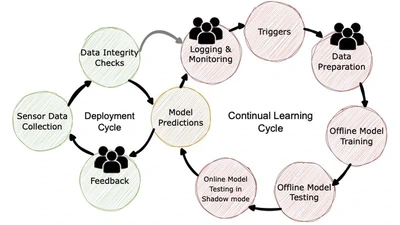
Particle accelerators rely on the precise synchronization of thousands of components, but data distribution drifts often limit the long-term deployment of machine learning …
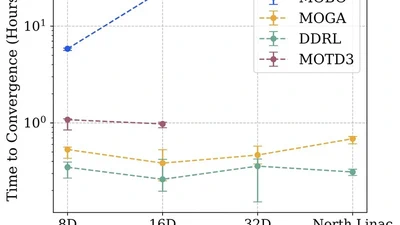
Differential Reinforcement Learning outperforms Multi-objective TD3, Multi-Objective Bayesian Optimization, Multi-objective Genetic Algorithms on highly complex constrained …
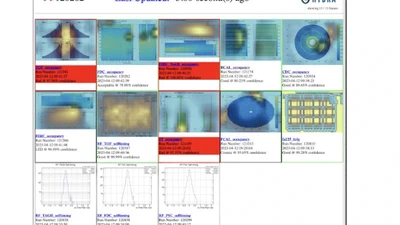
Hydra is a system that utilizes computer vision to perform near real time data quality monitoring. Since then, it has been deployed across all experimental halls at Jefferson Lab, …
This paper presents a distance-preserving machine learning approach for making uncertainty-aware predictions of accelerator capacitance. The method preserves geometric …
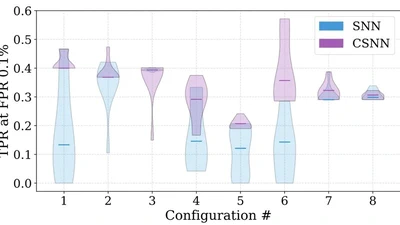
Conditional Models to handle data drifts due to changes in beam configuration changes at SNS accelerator.
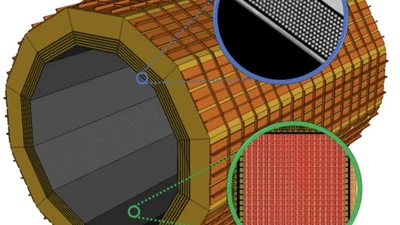
This is an opportune time for artificial intelligence (AI) to be included from the start at the upcoming Electron Ion Collider facility and in all phases that lead up to the …
This paper presents a conditional variational autoencoder (CVAE) approach for predicting high-voltage converter module (HVCM) faults in the SNS accelerator. The multi-module …
Surrogate models based on machine learning are increasingly used to accelerate optimization and control of particle accelerators. This paper presents methods for quantifying …